FleetPanda is now SOC 2 Compliant! Learn More →



Fuel delivery operations have a lot of moving parts. You buy product at the rack. Orders come in from phone calls, portals, and tank monitors. Drivers are out in the field. Paper tickets get lost. Invoices go out late. And somewhere in the middle, margin leaks out.
Fuel delivery software brings all of this under control. The good ones no longer stop at dispatch. They cover the full operation: what you buy, what you plan, what you deliver, what you reconcile, and what you bill.
This guide breaks down what fuel delivery software does, stage by stage.
What Is Fuel Delivery Software?
Fuel delivery software is the operating system for a fuel marketing or distribution business. It runs dispatch, driver work, routing, pricing, and reconciliation, and it feeds clean data into your back office.
It replaces paper tickets, spreadsheets, whiteboards, and phone calls with one connected system.
A complete platform handles:
Sourcing and supplier contracts: day deals, spot buys, GPO and rack pricing
Order creation from every source: call-ins, recurring schedules, tank monitors, customer portal, sales team
Cost-aware dispatch, so each truck loads at the terminal that protects your margin
Route planning and shift planning
Live driver tracking and two-way communication
Digital proof of delivery and meter-captured volumes
Shift reconciliation, truck balancing, and retain tracking
A clean push of every delivery to your back office for invoicing and accounts payable
Most distributors run separate tools for buying, dispatch, routing, and accounting, then spend hours moving data between them. The point of one platform is that the data moves on its own.
Stage 1: Sourcing and Buying
The Problem
Your buyer picks up a day deal or sets an allocation plan in the morning. By 10 AM, half the drivers are loading at the wrong terminal because nobody told them. The margin you negotiated never reaches the truck.
What FleetPanda Does
Supplier contracts and sourcing. Hold your supplier agreements, allocations, and contract terms in the system instead of in a spreadsheet on one person’s desktop.
Best Buy, or cost-aware dispatch. Pull in daily prices from your price service, your suppliers, or your own sheets. The system compares landed cost across terminals and shows dispatchers the cheapest viable load for each order, with haul cost and distance accounted for.
The value is not dispatcher minutes saved. It is that every truck stays in sync with the buying decision, so the margin your buyer worked for actually shows up on the invoice.
Pricing automation. Daily fuel prices combine with each customer’s contract terms, including margins, delivery fees, and volume discounts, to generate accurate pricing automatically. Prices sync to orders and carry through to the invoice.
Click here to learn more about pricing management →
Stage 2: Order Management and Dispatch
The Problem
Orders come from everywhere: phone calls, emails, recurring schedules, tank monitor alerts, customer portals, sales reps. Without a central system, dispatchers spend their mornings pulling data from different places, creating orders by hand, and working out who should take what. That is where errors start.
What FleetPanda Does
Centralized order well. Every order lands in one place, whatever its source. Dispatchers see status, customer details, product, and planned gallons on one screen.
Click here for more details on FleetPanda’s dispatch dashboard →
Recurring order automation. Set the schedule once for repeat customers. Orders are created on the right days, ready to dispatch.
Click here to see how this works in FleetPanda →
Tank monitor integration. When a customer’s tank drops below your threshold, an order is created automatically. This prevents run-outs and makes keep-fill contracts manageable without manual tracking. FleetPanda integrates with 11 tank monitor brands.
Click here to see how it works →
Customer portal. Customers place orders, track deliveries, and view history online. Portal orders flow straight into your dispatch queue.
Sales app. Your sales team can raise orders, check customer history, and see account activity from the field, without calling dispatch.
Credit check at order creation. Customers over their credit limit are flagged before dispatch, not after the fuel is in the tank.
Live driver tracking. See every driver on a map, with their schedule, route, and truck inventory down to the compartment. When a call-in comes in, find the nearest driver with capacity and assign in seconds.
Drag-and-drop shift planner. Build schedules by dragging orders onto shifts. Reassign by dragging to another driver. The driver is notified instantly.
Weekly shift planner. Plan the week ahead. See who is available, who is off, and where the gaps are.
Route Builder. Build optimized routes for the day instead of sequencing stops by hand. The planner accounts for truck and product constraints, time windows, and site access rules, and gives dispatchers a workable morning plan they can reshuffle manually when the day changes.
Common carrier and third-party logistics. Tender orders to outside carriers and track them alongside your own fleet, so one board shows the full day no matter who hauls it.
What Customers Say
“I used to come in at 5AM to fit orders into driver schedules. Almost 60% of our business is recurring orders - I was creating the same orders every week. Now with FleetPanda, I automate all of that. I work normal hours.”
Dispatcher, leading fuel marketer, Ohio
Stage 3: Delivery
The Problem
Drivers handle multiple stops, multiple products, different tank setups, and customer-specific instructions. On paper tickets, things go wrong: wrong product in the wrong tank, missing signatures, lost paperwork. And every question becomes a phone call to dispatch.
What FleetPanda Does
Mobile driver app. Drivers get their full schedule, customer details, and delivery instructions on their phone.
Full daily schedule with customer, product, and supplier details
Turn-by-turn navigation to each stop
Delivery instructions such as gate codes, tank locations, and site contacts
Pre-trip and post-trip checklists, including DVIR
Offline mode for areas with poor coverage
Want to see an overview of FleetPanda’s driver app? Click here →
QR code and barcode scanning. Every asset gets a code. Drivers scan before fueling, and the app confirms which product belongs in that tank. This is what stops cross-fills. On sites with many tanks, drivers tap the geo-pin to navigate to the exact tank.
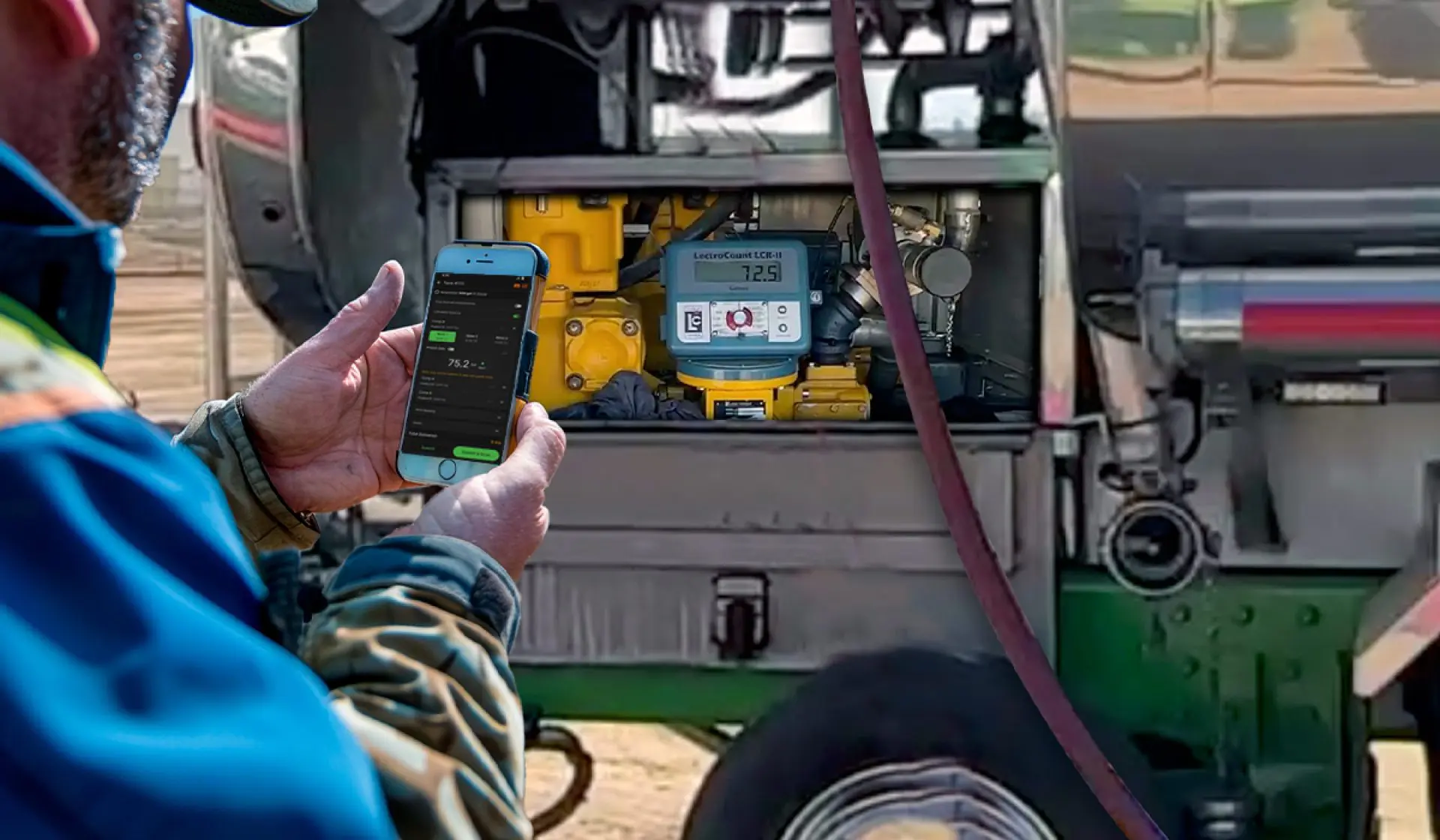
Meter integration. The app connects to the electronic meter on the truck, so every gallon loaded or delivered is recorded automatically. No walking back and forth to read a meter, no transcription errors, and a clean audit trail for every drop. FleetPanda supports LCR iQ, LCR-II, LCR-600, and TCS 3000, with a working range of roughly 100 to 125 feet between the meter and the driver’s phone.
Blended deliveries. For in-tank blends, the dispatcher plans the recipe and the driver records what actually went in per product. Any deviation from the plan is confirmed by the driver on the spot, and the invoice follows the confirmed gallons.
Digital proof of delivery. Signatures, BOL photos, and delivery notes are captured in the app, timestamped and attached to the order.
Real-time updates. Order changes reach the driver immediately. Completed deliveries appear on the dispatch board immediately. No phone calls either way.
What Customers Say
“Whether it was the young drivers or the 20-30 year veteran drivers—they all picked it up quick because the technology was user friendly.”
Patrick McNeece, Partner, McNeece Bros
“We’ve actually had a lot of success in impacting the front end process, which is where the driver sources the fuel. So it provides a great platform, much better than text or email or any other means, to make sure that the driver knows which loading number to use at which terminal and to make sure that we’re optimizing our purchasing strategy.”
Carl Kleimann, Moffitt Services
Stage 4: Reconciliation
The Problem
At the end of each shift, someone has to work out what actually happened. How much was loaded, how much was delivered, what is still on the truck, and what is left of each product. On paper, that means sorting through stacks of BOLs and typing it all into the accounting system. Every hour of that delays an invoice.
What FleetPanda Does
Truck balancing. The system tracks starting inventory, loads, deliveries, and ending inventory through the shift. Discrepancies are flagged the same day, not a week later.
Retain tracking. Leftover product stays traceable to the BOL it came from, per product, so what is on the truck at the end of the shift is accounted for correctly.
Delivery validation. Every delivery arrives with digital proof: timestamps, signatures, photos, notes, meter readings. Validation takes minutes instead of hours.
Automatic BOL linking. Load orders and delivery orders are matched automatically, giving you a complete trail from supplier to customer.
Stage 5: Back-Office Sync and Billing
Reviewed deliveries go to your accounting system with the price, the cost, the customer, the terminal, and the BOL data attached. As soon as someone in the back office reviews a delivery, it can be sent through. There is no waiting for paperwork to come in from the field.
That means invoicing on the sell side and accounts payable on the buy side both work from the same verified record.
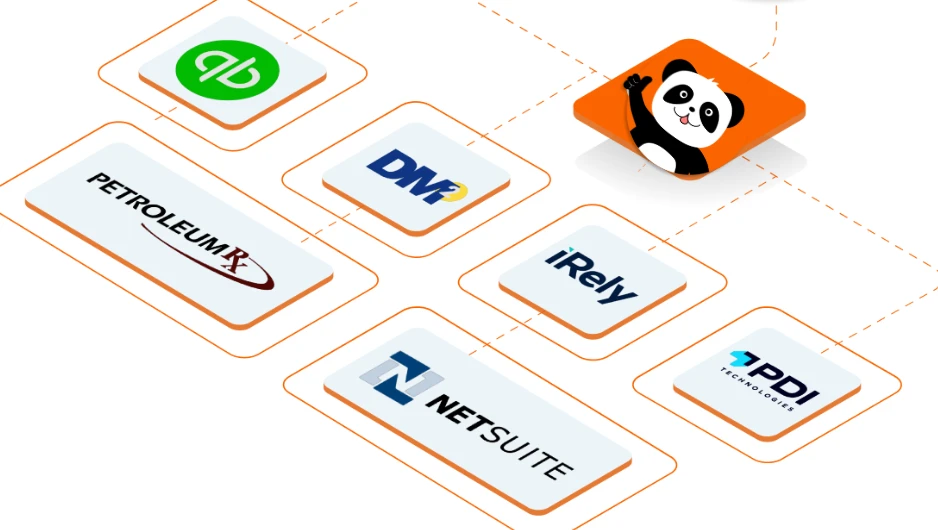
FleetPanda integrates with major back-office systems including NetSuite, DM2, Cargas, PetroleumRX, and QuickBooks (Desktop and Online).
Understand how FleetPanda’s back-office integration system works →
What Customers Say
“Automating our billing processes is saving our billing department a considerable amount of time while ensuring accuracy.”
Carl Kleimann, Owner/Partner, Moffitt Services
Reporting and Management Reporting
For dispatchers: live boards showing driver locations, order status, and truck inventory.
For operations managers: driver performance, delivery times, fill rates, and asset utilization, so you can find the bottleneck.
For owners and executives: management reporting on customer profitability, cost to serve, volume trends, and operational cost, which is what you need for pricing, expansion, and acquisition decisions.
Beyond Fuel: One Platform, Several Business Lines
Most marketers do not only haul fuel. FleetPanda runs on-site fueling, bulk transport, propane and heating oil, and lubricants on the same platform, with the product and packaging rules each line needs.
It also covers leased asset management: tanks and equipment you place at customer sites, with the billing, service, and ownership tracking that goes with them.
Roles and permissions. Companies that acquire, or get acquired, can bring several operating companies into one system or run them as fully separate organizations, with access controlled by role.
Integrations
Your fuel delivery software should connect to the rest of your tech stack:
Back office and accounting: push verified deliveries for invoicing and payables
Tank monitors: Otodata, TankScan, Graco, Anova, Wesroc, Ecogreen, Centeron, MyTankInfo, SmartTank, Pneumercator, Gaslog (Anova)
Meters: LCR iQ, LCR-II, LCR-600, TCS 3000
Price sources: your price service, supplier files, or your own spreadsheets
Why FleetPanda for Fuel Delivery
FleetPanda is a cloud platform built by fuel people for fuel people. It covers the full operation: buy, plan, dispatch, deliver, reconcile, and bill.
Built for fuel. Not a generic fleet or delivery tool with fuel bolted on.
Several business lines on one platform. On-site fueling, bulk transport, propane and heating oil, lubricants, leased assets.
Implementation. Go live in 6-8 weeks with hands-on training.
Ease of use. Veteran drivers and new hires both pick it up fast.
Support. First response in under 10 minutes, and 24x7 support for drivers, because your drivers do not work office hours.
Security. SOC 2 Type 1 compliant. US hosting across multiple data centers, encrypted at rest.
Updates. We ship 4-6 platform updates per month.
What Customers Say
“In my 35 years in the trucking business, I’ve used every dispatch software. But I’ve been very impressed with FleetPanda. It’s been very good. They’re a partner, not a vendor.”
Stephanie McNally, President, 3L USA
“It’s like having our own software engineering team. They tailored the platform to our needs and are always available.”
Patrick McNeece, Partner, McNeece Bros
Frequently Asked Questions
What is fuel delivery software?
A platform that runs the full operation for a fuel marketer or distributor: sourcing and pricing, order creation, dispatch and routing, driver work in the field, shift reconciliation, and the handoff to your back office for invoicing and payables.
What are the main features of fuel delivery software?
Supplier and sourcing management, cost-aware dispatch, centralized order management, route and shift planning, live driver tracking, a mobile driver app that works offline, tank monitor integration, QR scanning, meter integration, digital proof of delivery, truck balancing and retain tracking, management reporting, and back-office sync.
How does fuel delivery software improve dispatch efficiency?
It puts every order in one place, creates recurring and tank monitor orders automatically, shows live driver locations and truck inventory, and lets dispatchers assign by dragging. Call-in orders get assigned in seconds instead of three phone calls.
Can fuel delivery software prevent delivery errors?
Yes. QR scanning confirms the right product goes in the right tank. Meter integration captures exact quantities. Digital instructions give the driver the details at the stop. Together these remove the two most common errors: cross-fills and wrong-product deliveries.
How does fuel delivery software speed up invoicing?
Delivery data moves from the field to the back office on its own. Truck balancing and validation are digital. BOLs link automatically. Once the back office reviews a delivery, it can go to your ERP right away.
Does it help with buying, not just delivering?
Yes. Supplier contracts, allocations, and daily prices live in the system, and dispatchers see the cheapest viable terminal for each load. That is how the buying decision reaches the truck.
Does fuel delivery software work offline?
Yes. Drivers can see order details, record deliveries, and capture signatures without coverage. Data syncs automatically when connectivity returns.
Does it handle more than fuel?
Yes. On-site fueling, bulk transport, propane and heating oil, lubricants, and leased assets all run on the same platform.
How long does it take to implement fuel delivery software?
Implementation timelines vary by vendor. Legacy systems can take 6-12 months. Modern cloud-based platforms like FleetPanda typically go live in 6-8 weeks, including training and integrations.
Get Started
The right fuel delivery software connects buying, dispatch, the field, and the back office, so an order moves from creation to invoice without anyone retyping it. Dispatchers get visibility. Drivers get what they need at the stop. Billing gets accurate data as soon as it is reviewed.
See how FleetPanda runs the full order-to-cash workflow. Book a demo →